
Strengthening How People Lead and Work at National Bank of Moldova
Contributing to the development of the culture, as well as the individual and team practices, of a central bank in an Eastern European country is not a common experience. Because let’s be honest: it is not typically the type of place where we expect innovative leadership or communication behaviors to flourish. And yet, the National Bank of Moldova (NBM) took up the challenge! Over a period of three years, they decided to embark on a major development journey.
I spent the first part of my professional life in the financial sector, in Luxembourg, as an HR manager and Head of HR for almost 20 years before deciding to give a new direction to my career. Over the last 12 years, I have therefore been accompanying individuals, teams, and organizations through their challenges and development. I am a certified and accredited professional coach, specializing in coaching executives and managers. I also spend quite a lot of my professional time traveling around the world to give workshops, mainly on team management, leadership, HR topics, and soft skills development.
That journey of accompanying NBM in its transformation into a learning organization has been one of the most pleasant and rewarding experiences in my career because of the diversity of the assignments I have been asked to undertake. It has consisted of individual coaching, team coaching, training, practical workshops, team reflection, and consulting. It is not that often that I am offered such a palette of actions to accompany one organization through its development. It allowed me to see the evolution of NBM over time.
What can we learn from such an experience? Actually, many things.
The main purpose of the different activities I carried out for NBM, whether individually or in teams, was to develop, update, and reinforce a mindset better adapted to the changing world and the new challenges people face.
The eagerness of NBM participants, during the various coaching sessions and workshops I conducted demonstrated a genuine, widely shared appetite for change in the way leadership is exercised at NBM, as well as in the way people work together and communicate.
Organizational change can only be effective if everyone is fully aware that success does not depend on technology, processes, and procedures, but first and foremost on people.
According to a McKinsey study (1), 70% of change management projects do not achieve their objectives, mainly because of human factors, such as a lack of communication, fear, resistance to change, or poor leadership.
Therefore, it made perfect sense that, in seeking to become a learning organization, NBM should work on organizational culture first. Culture is the soil in which all the processes of the organization will take root. Culture is a guiding principle, the backbone from which all practices will develop in a coherent way. Furthermore, as the DNA of the organization, a culture can only be effective if each individual can relate to and identify with it.
This type of organization is more used to working in silos. The word “division” used to describe each line of business is self-explanatory! Therefore, the different activities focused on the way people work together, make greater use of collective intelligence, trust one another, and develop solidarity.
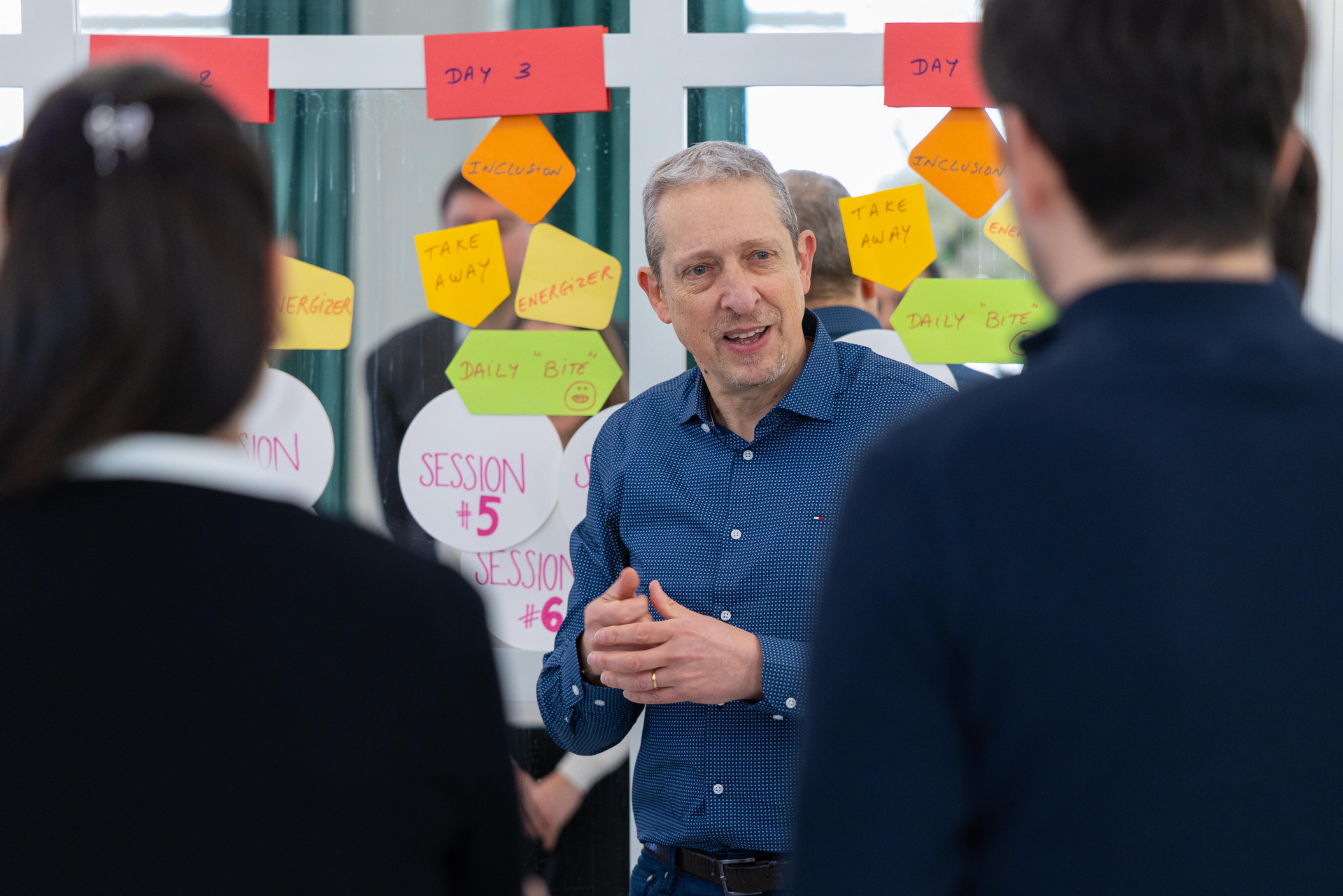
The way people communicate with one another has also been a key focus of our work. Communication should not only be clear and effective in order to avoid misunderstandings and frustrations, but should also be constructive and enable cooperation. In that respect, particular attention was paid to how to foster a culture of feedback in which each individual becomes morally responsible for the development and growth of others.
But, of course, all these initiatives can only be effective with the development of solid, consistent leadership across the organization.
Leadership has been revisited in light of new trends and challenges, focusing on the skills each leader has to work on to face today’s challenges. Critical thinking, emotional intelligence, agility, metacommunication, resilience, creativity, and the ability to act as a change agent have been among the competencies we covered during our workshops. Developing a better understanding the different generations and how they complement one another has also been part of the curriculum we covered.
Above all, understanding how to build trust and create the right conditions for motivation and engagement to flourish was a key focus throughout our work.
According to a study published in Harvard Business Review, 58% of teams fail because of a lack of trust and transparency in professional relationships. In that respect, the role of the leader is really key!
The introduction of the role of a manager-coach, acting with humility to help team members grow while developing their skills and improving their performance, was not an obvious step for such an organization, where the top-down approach is more commonly accepted by both management and direct reports.
Nevertheless, the change in mindset was observable over the months and years. There is still a long way to go to become an organization fully adapted to the challenges of the 21st century, but a solid ground has been established for management to build upon.
The willingness and eagerness I have witnessed within teams will, I am sure, enable the completion of such a necessary evolution.