
In the Green City of Ljubljana: My Learning Journey
I have continued my lifelong learning journey. I am eager to learn, and my motivation is driven by a belief in my own capability and the value of studies.
My learning journey with the CEF team began via the "Communicating Green Reforms Program," which sparked my interest in carbon tax and sustainability. It was stated in the program that unless the reform is clearly communicated to stakeholders, it risks being misunderstood. In this context, it is crucial to understand the carbon tax and the Carbon Border Adjustment Mechanism (CBAM). Before joining this program, I had a background in environmental taxation through my academic paper titled "Environmental Externality Taxes in Cryptocurrency Mining". "We are pleased to inform you that you have been selected to participate in our learning event on Green Taxation: Progress on CBAM - Center of Excellence in Finance." When I received this acceptance, my heart's voice said that I was beginning a new learning journey. In this experience, the CEF team, which facilitates learning and knowledge sharing, became my tour guide and organizer.
Before setting foot in Ljubljana as a participant, I watched YouTube videos and read blogs about the city to explore its culture and historical background. For me, getting to know a city starts with its cuisine, as it reflects its culture. In a crystal shop in Ljubljana, I witnessed elegance, design, and craftsmanship in beautiful crystal glasses, plates, trays, and bowls. I adorned my crystal sugar bowl with Turkish delights. Also, Piran salt, dating back 700 years, caught my interest. I visited a salt shop to experience this salt, which is produced using traditional methods and demands immense labor under challenging natural conditions.
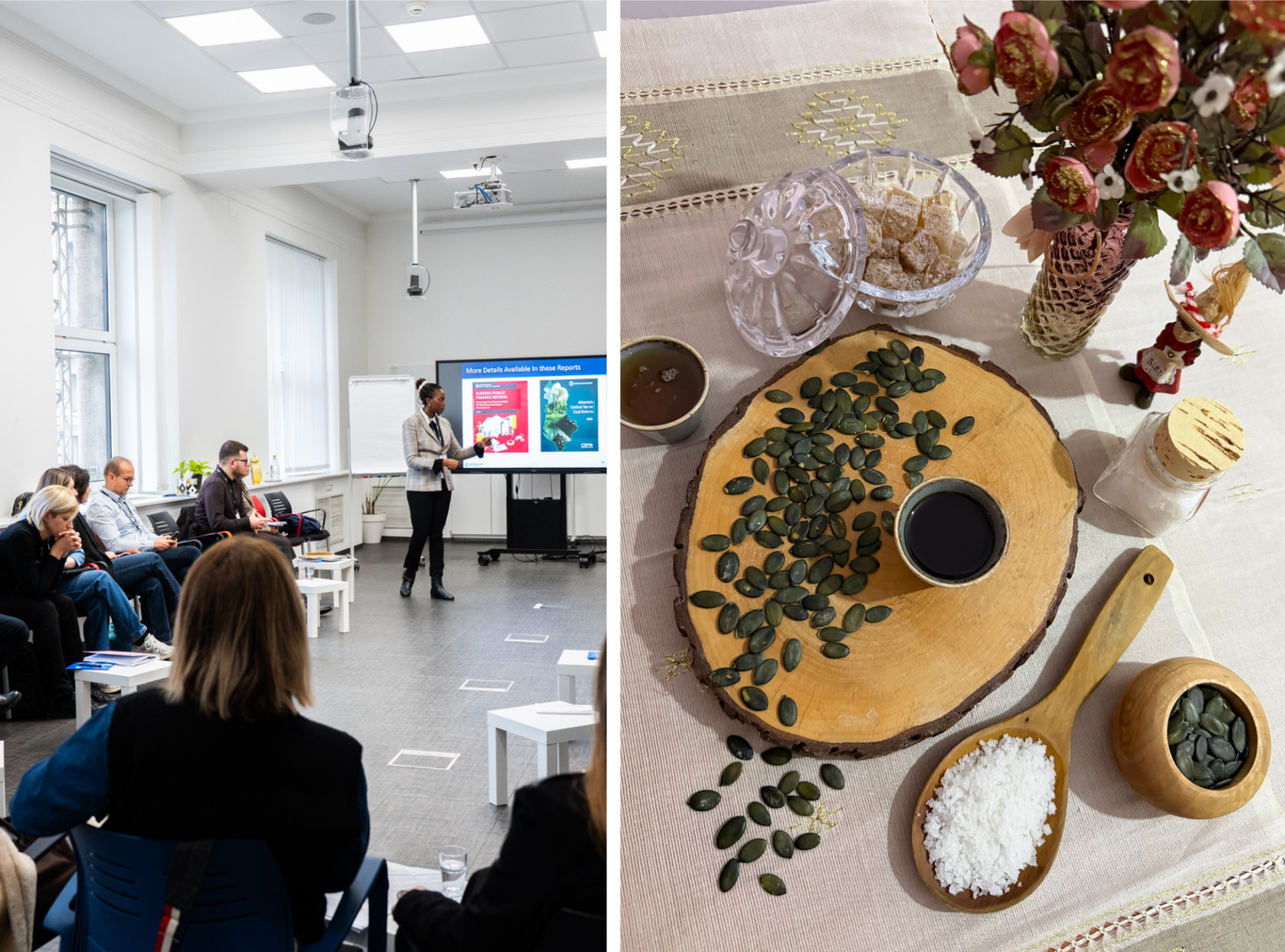
Have you heard of salt flowers? They are meticulously harvested from the surface of the salty water with a delicate touch. Their indescribable aroma elevates the salads on my table with a touch of elegance. I also discovered Ljubljana's famous pumpkin seed oil, known as "green gold", which dates back to the 18th century. For breakfast, I chose honey from Slovenian beekeeping, inscribed on the UNESCO Representative List of the Intangible Cultural Heritage of Humanity, along with wooden kitchenware specific to Ljubljana. To keep these cultural memories alive, I have added a photo of my own composition to this blog post.
Beyond this cultural richness, it is no coincidence that Ljubljana, a green and sustainable city, was chosen for this workshop. Why? Because Ljubljana was named the European Green Capital in 2016. The river flowing through the heart of the city becomes a mirror reflecting the architectural structures and the dance of light in the evening. I whispered my joy into the river's flow. In anticipation of the workshop, I dived into research on the post-2026 CBAM framework as a fundamental tool of the EU Green Deal. While exploring how its implementation will look in 2026 and beyond, I came across a post on Slovenia's Financial Administration portal. This source served as a helpful guide.
This process is not easy for firms. Why not? While researching the topic, I came across the EU's "Carbon Border Adjustment Mechanism: Questions and Answers" containing 135 entries, which clearly shows how complex the mechanism is, particularly when it comes to verification. Turkiye ranks third among the top sources of CBAM-covered goods, meaning the mechanism has important implications for its firms. This made the workshop especially relevant for me.
For example, when firms' actual emissions are not approved by the EU or cannot be fully determined, default values are applied in calculations, often with a mark-up. This can increase reported emissions and financial obligations for exporters.
CBAM and carbon tax: What did we talk about? A country can set up its own Emissions Trading Systems (ETS), apply a national carbon tax, or test a hybrid model. By 2026, carbon taxation or ETS will be established in 40 EU jurisdictions, with roughly 80 worldwide. It is crucial to determine whether these systems are aligned with or recognized by the EU, as this allows companies to deduct local carbon payments from their CBAM obligations.
The CBAM definitive period started in January 2026. With the transition period ending, firms must fulfill new obligations and start buying certificates from February 2027. At the same time, free allocations under the EU ETS will gradually diminish, increasing financial pressure on firms. In a nutshell, the workshop covered the impacts of CBAM, the challenges scope, and the implementation of CBAM along with broader topics such as carbon pricing and taxation, carbon leakage, default values and mark-ups, emissions, decarbonization, reporting, certificates, verification, potential next steps, and case studies from Albania, Slovenia, and Serbia.
During the entire workshop, the CEF team stood out for its sincerity, hospitality, and professionalism.
I am already looking forward to continuing this learning journey together!